
The 2 Step Process That Puts an End to Burnout
Jun 16, 2026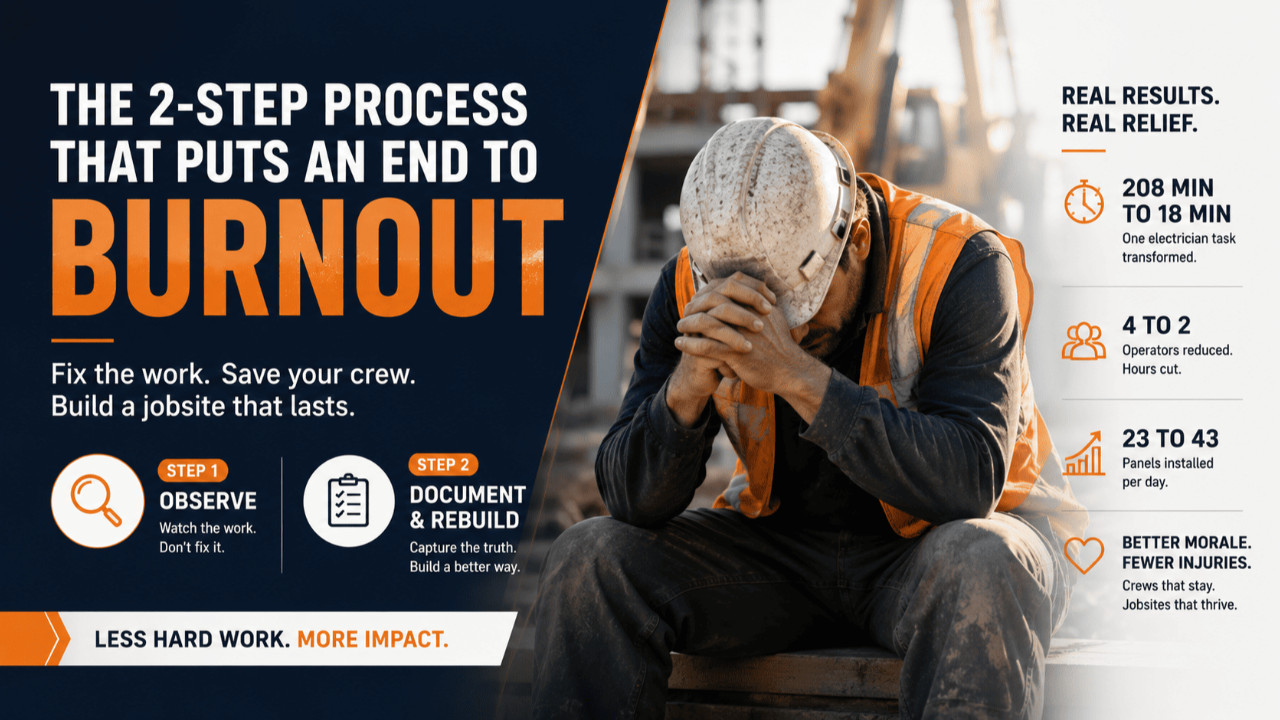
What if burnout on your jobsite has nothing to do with weak people and everything to do with hard work nobody stopped to rethink? The fix takes 2 steps. First, observe the work without fixing anyone.
Second, document the current condition and rebuild the task around the worker. Nearly 60% of construction pros report regular burnout, and most fixes never touch the real cause. At Depth Builder, we train PMs, supers, and foremen to run this exact process on live jobsites every week.
Why Burnout in Construction Outlasts Every Pep Talk
Most burnout advice tells you to rest more, breathe deeper, and push through smarter. None of that touches a task that beats up a body for 10 hrs a day. The work stays hard, and your crew keeps paying for it.
Here is where the standard fixes fall short:
- A rest day does not shrink a task that runs 208 mins when it should run 18.
- A toolbox talk on stress does not lighten the material your crew carries 4 extra times per cycle.
- A motivational meeting does not repair a workflow that forces 60 hr weeks.
- An extra hire does not remove the inefficiency, it only spreads the pain to one more person.
Skilled craft workers go numb to poor ergonomics after years in the field. Supervisors often wave off ideas from the crew as whining. So the cycle spins on, because nobody stops to study the work itself.
Step 1: Observe the Work Without Fixing Anyone
You walk out, pick one installer or one crew, and watch the task from start to finish. You ask permission first with one honest line: may I watch your work? Then you do the hardest thing a construction leader ever does, which is stay quiet.
Follow these rules while you watch:
- Observe only, and step in just when someone faces immediate danger.
- Resist the urge to correct, coach, or quote a better method on the spot.
- Write down every step, every lift, and every walk back to the gang box.
- Go micro with your notes, because the smallest motions hide the biggest waste.
- Mark the exact moments where the worker strains, waits, or doubles back.
Walking up and fixing someone feels like a shank to the person doing the task, even when you mean well. Your common sense comes from your frame of reference, and the installer does not share it. Quiet observation builds the trust that every improvement after this depends on.
Over-functioning drains you too, and we broke down that pattern in our post on field leader burnout and over-helping.
Step 2: Document the Current Condition, Then Rebuild the Task
You cannot prove improvement without a benchmark. Step 2 turns your notes into a current condition, which means real numbers on paper before anything changes. Without that baseline, you get feel-good moments instead of measurable gains.
Run it like this:
- Time the task as it runs today and write that number down.
- Count the steps walked, the lifts made, and the hrs burned per cycle.
- Ask the worker which part of the task wears the body down most.
- Rebuild the sequence so material, tools, and hands move less.
- Deploy the new process side by side with the crew, never by memo.
- Compare the new numbers against the baseline every single week.
The redesign happens with the worker, not for the worker. The crew owns the new method because the crew helped build it. Buy-in stops being a battle and starts being automatic.
What Changes When the Hard Work Leaves the Jobsite
Our Sweat Equity Improvement (Jobsite Efficiency & Worker Care) training teaches this process across 7 two-hour live virtual sessions. Depth Builder clients have posted results that sound made up until you watch the process work.
The numbers tell the story:
- One electrician task dropped from 208 mins to just 18 mins.
- Forklift work that consumed 4 operators at 60+ hrs a week now runs with 2 operators at 40 hrs each.
- Panel installation climbed from 23 to 43 panels a day without new tools or new hires.
The quieter wins matter just as much. Crews report better morale, fewer aches, and shorter weeks. Turnover drops because good hands stop looking for an exit, and the warning flags we listed in our guide to employee burnout signs start disappearing from your huddles.
How Jesse Walks You Through It
Jesse Hernandez graded ditches in Texas and worked as a plumbing journeyman before a promotion to superintendent threw him in with zero leadership training. He answered every schedule miss the old way, telling crews on Friday to work the weekend.
He found a better path, adapted it to construction, and now trains PMs, supers, and foremen to spot brutal tasks, benchmark the current condition, and rebuild the work so the jobsite stops grinding people down.
You leave with a repeatable process, not a one-time fix. That is the difference between patching burnout and ending it.
Two Steps Today, a Stronger Crew by Friday
Burnout ends when the hard work ends, and the hard work ends when someone observes it and rebuilds it. You now hold the 2 steps that make it happen. Pick one crew this week, watch one task, and write down your current condition.
If you want a guide who has run this process on real jobsites, grab a seat at our free SQI webinar or contact Depth Builder today. Your crew will feel the difference fast.