
Construction Communication Tip: Stop Trying to Impress People
Oct 07, 2026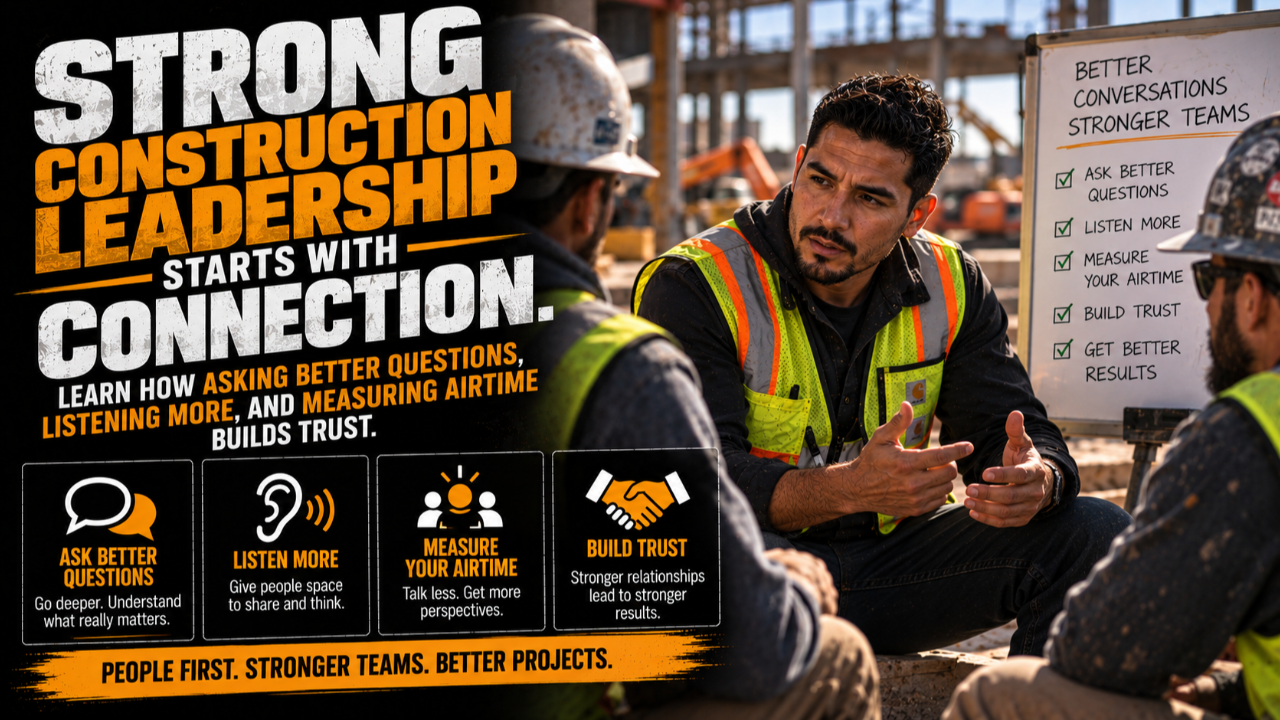
If you struggle to connect with people, stop trying so hard to make yourself interesting. Get interested in the human being standing in front of you. Ask better questions, listen to their answers, and resist dragging the conversation back to yourself. If you want a simple measurement, track your airtime: they should probably be talking more than you are.
Want People to Like You More? Stop Trying to Impress Them
Your resume doesn’t matter in real life.
There. I said it.
Yes, your experience matters. Your certifications matter. The projects you’ve built matter. When you’re applying for a job, bidding work, or updating LinkedIn, put that stuff to work.
But when you’re standing face-to-face with another human being?
Nobody wants you to verbally hand them your resume.
I learned this the hard way.
For a long time, I thought connection came from proving I had something valuable to offer. If I could show people what I knew, what I had done, and why I belonged in the room, they would respect me.
Turns out, I had it backwards.
The shift that changed the game for me was stupid simple:
Be more interested than interesting!
Key Questions Answered
-
Why can trying to impress people actually hurt connection?
-
How can construction leaders become better at connecting with crews and peers?
-
What questions can I use when I don’t know what to say?
-
Why does asking questions build influence?
-
How can I tell if I’m talking too damn much?
Why Doesn’t Your Resume Build Real Connection?
Think about the classic one-upper.
You tell them you went fishing.
They caught a bigger fish.
You mention a vacation.
They went somewhere better.
You talk about a difficult project.
They worked on one twice the size with half the manpower while walking uphill both ways in the snow.
You know that person.
Hell, you might be that person.
I’ve done it too.
Most of us aren’t trying to be jerks. We think sharing our experience creates credibility. We think being interesting makes people interested in us.
But there’s a point where sharing becomes competing.
Instead of listening, we’re waiting for our opportunity to jump in with our story.
That doesn’t create connection.
It kills it.
What Mindset and Behavior Shifts Make You a Better Construction Leader?
I break this down into two shifts.
Mindset shift: Learn more about the person in front of you.
Behavior shift: Ask more questions.
That’s it.
Simple doesn’t mean easy.
Construction professionals are trained to solve problems. We see something, assess it, make a decision, and move. That ability can make you incredibly valuable on a project.
But people aren’t RFIs.
Sometimes leadership means resisting the urge to immediately prove what you know and getting curious about what somebody else knows.
That’s a leadership skill.
And it’s one reason conversations like this belong inside the Construction Leadership Lab. Leadership isn’t just schedules, production, and technical knowledge. The Lab gives construction leaders a place to work on the human side of leading: communication, connection, questions, accountability, and learning from other leaders who have been in the mud too.
How Do Better Questions Help Construction Leaders Connect?
People get hung up on finding the “perfect” question.
Forget perfect.
Ask the curious question.
Somebody tells you they’ve been with the company 15 years?
“Damn. What’s kept you here?”
They tell you they traveled across the country for work?
“What’s been your favorite project?”
They mention a problem with their crew?
“What do you think is really causing it?”
Then listen.
The important part is what happens after the first question.
They’re going to give you some intel. Grab onto something they said and go deeper.
“What does that mean?”
“Why was that important to you?”
You don’t need to perform.
You need to give a damn about the answer.
Q: What if I’m naturally bad at conversation?
Start with stock questions. You don’t need to become the world’s greatest conversationalist overnight. Get some reps.
What Questions Can You Keep in Your Back Pocket?
When I was building this habit, having stock questions helped.
Try these:
-
Why are you here?
-
What are you hoping to get out of this?
-
What’s your favorite way to make people laugh?
-
How did you get into what you do?
These aren’t scripts you blindly fire at somebody.
They’re door openers.
Once they start talking, stop worrying about your next brilliant question and listen for something worth exploring.
That’s where the real conversation starts.
What Are Good Conversation Starters on a Construction Jobsite?
A jobsite is one of the best places to practice this.
We can walk past the same people for months or freaking years and know almost nothing about them.
Start with:
“What do you like about your trade?”
Then:
“Are you local, or are you traveling for this job?”
Then:
“What’s different about this project compared with other projects you’ve been on?”
Those questions work because they aren’t complicated.
You can adjust them for an estimator, superintendent, PM, foreman, owner, or apprentice.
“What made you decide to become an estimator?”
“What made you choose this trade?”
“What’s different about this company compared with places you’ve worked before?”
Then shut your mouth and listen.
For someone who normally sees management show up to correct something, speed something up, or ask why something isn’t finished, genuine curiosity can feel radically different.
You’re communicating:
I see you. You have experience. Your perspective matters.
That builds connection.
Why Does Being Interested Work Better Than Being Interesting?
I figured this out after noticing something weird.
There were people I really liked and respected, but when somebody asked me what I knew about them, my answer was basically:
Nothing.
They knew a bunch about me.
I knew almost nothing about them.
Why did I like them?
Because they had been interested in me.
They asked about my thinking. My work. My ideas. My challenges.
I walked away feeling heard and appreciated, and my brain assigned that experience to them.
That was the awakening.
People don’t necessarily remember your credentials.
They remember the experience of interacting with you.
That matters in construction leadership training because influence doesn’t come from a title alone. The superintendent, PM, foreman, or executive who can make people feel valued has an advantage when it’s time to solve problems, build trust, or have difficult conversations.
Q: Is this manipulation?
Not if you actually care. The goal isn’t to run a questioning technique on somebody. The goal is to become genuinely interested in the human being standing in front of you.
Why Does Pressure Make Connection Harder?
This gets harder when you need something.
You need the sale.
You need buy-in.
You need somebody to agree with your plan.
Pressure makes us rush.
We start pushing toward our objective instead of paying attention to the person.
Pump the brakes.
The sale doesn’t have to happen this minute.
The next meeting doesn’t have to be forced into this conversation.
Build the connection first.
You can always say, “This was a great conversation. I’d like to stay in touch.”
Patience creates space for trust.
How Can You Measure Whether You’re Talking Too Much?
Measure your airtime.
In a three-to-five-minute conversation, who made the most mouth noise?
If it was you, pay attention.
I’m guilty of giving somebody ten years of history and context before answering a simple question. I’ve watched people’s eyes glaze over while my mouth apparently decided it was an independently operated business.
So give yourself a measurement.
If they talk for three minutes and you talk for two, good.
You’re creating room.
You’re learning.
You’re practicing being interested instead of desperately trying to be interesting.
And yes, it takes reps.
Your technical experience might get you promoted.
Your resume might get you into the room.
But your ability to connect with people determines what happens once you’re there.
Put It to Work
On your next jobsite walk, meeting, conference, or conversation, give yourself one assignment:
Learn three things about somebody before telling them three things about yourself.
Ask.
Listen.
Follow up.
And measure your damn airtime.
You might be surprised how much more influential you become when you stop trying so hard to prove you deserve influence.
Keep Building the Skill
If you want to practice these kinds of leadership shifts around construction professionals who understand the work, step into the Construction Leadership Lab. It’s a place for real conversations, practical leadership development, and learning from other construction leaders not another highlight reel.