
Hard Work vs Burnout in Construction Leadership
Apr 21, 2026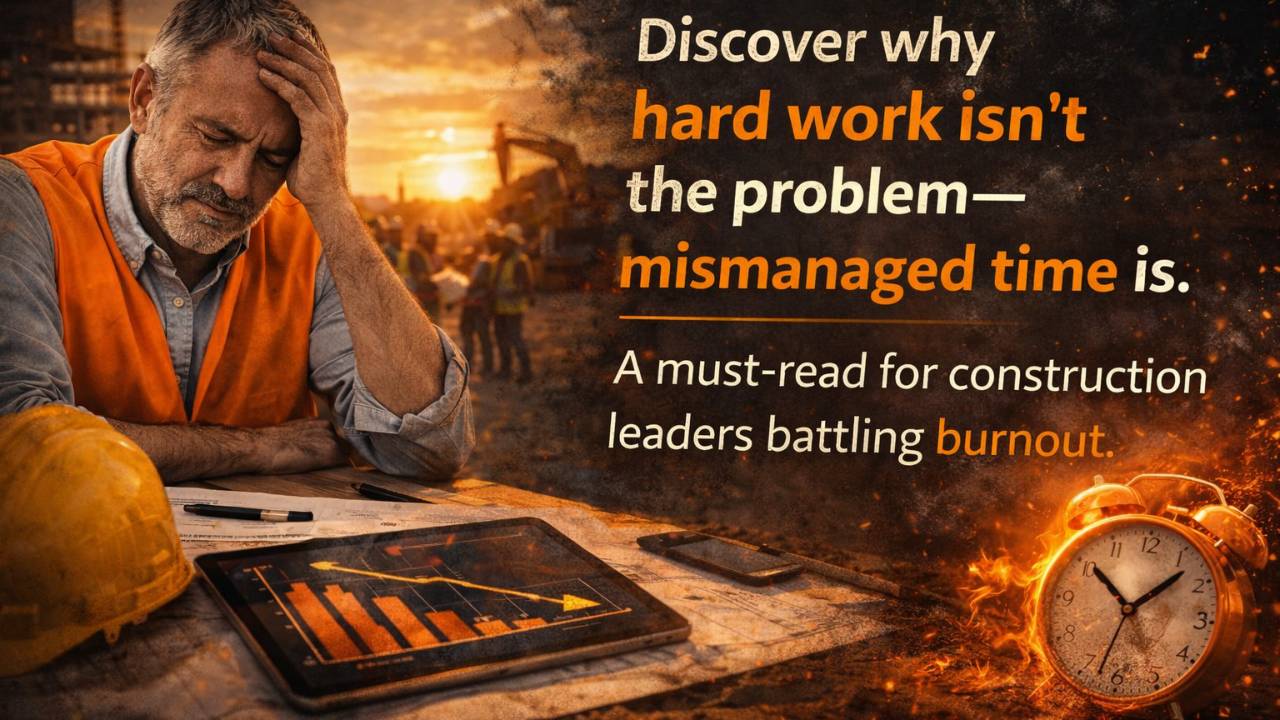
I used to wear exhaustion like a badge of honor.
Long days. Late nights. Early mornings.
Traveling job site to job site.
Running on fumes… and calling it commitment.
And for a long time, I thought that was the job.
But then something hit me on a plane ride home.
I was completely drained…
…and completely fulfilled.
That’s when I realized something most superintendents and foremen never stop to question:
Not all hard work is the same.
Key Questions Answered
- How do you tell the difference between good hard work and bad hard work?
- Why do so many construction leaders feel drained even when they’re “doing everything right”?
- How does time mismanagement lead to burnout (even if you’re working hard)?
- What should superintendents and foremen actually fix first?
What’s the Real Problem With Hard Work in Construction?
Let’s get something straight:
Hard work is not the enemy.
In fact, in construction, it’s required.
But here’s where most people screw it up:
They confuse draining work with meaningful work.
And worse…
They justify it as loyalty.
I’ve been there.
I’ve lived in that space where I told myself:
- “This is just part of the job.”
- “I’m being a good leader.”
- “I just need to push through.”
But deep down?
I was empty.
And I didn’t realize I was calling that emptiness commitment.
How Do You Know If Your Work Is Fueling You or Draining You?
This is where it gets real simple.
When you finish a day of work…
Ask yourself one question:
“Do I feel like I get to do this again tomorrow… or I have to?”
There’s your answer.
Because I’ve lived both sides:
The Draining Work
- You’re counting down the hours
- You’re mentally checking out
- You just want to be done
- You feel like you’re surviving, not leading
The Fueling Work
- You’re tired… but fired up
- You’re already thinking about what’s next
- You feel like you made an impact
- You’re energized by the challenge
Both are hard.
Only one is sustainable.
Why Do Superintendents Confuse Burnout With Loyalty?
Because in construction, we’ve been conditioned to.
We’re taught:
- Show up early
- Stay late
- Outwork everyone
And if you’re miserable?
That just means you’re committed.
That’s a lie.
I’ve seen too many superintendents and foremen:
- Stay in roles they hate
- Work for leaders who don’t support them
- Grind through environments that kill their energy
All because they think leaving means quitting.
No.
Staying in something that’s draining you isn’t loyalty. It’s avoidance.
Is It the Job… or the People?
Here’s where most guys get it wrong.
When work feels off, they blame:
- The company
- The role
- The workload
But they skip the real problem:
The people.
And I’ll say it straight:
If you’re waking up dreading work, it’s usually not the tasks, it’s who you’re doing them with.
Because I’ve done “bad work” with great people…
…and it didn’t feel bad.
And I’ve done “great work” with the wrong people…
…and it was miserable.
So before you blow up your career, ask:
- Is it the job?
- Or is it the environment I’m stuck in?
That clarity changes everything.
Why Time Management Is Actually the Root Issue
Here’s where this ties directly into the Time Management for Construction Webinar.
Most leaders think they have a workload problem.
They don’t.
They have a time ownership problem.
Because when your time is out of control:
- You say yes to everything
- You stay stuck in draining work
- You never prioritize what actually matters
- You lose control of your day—and your energy
And that’s when burnout shows up.
Not because you worked hard…
…but because you worked on the wrong things for too long.
What Is “Empty Work” (And Why It’s Killing You)?
Let’s call it what it is.
Empty work is:
- Meetings that go nowhere
- Reports no one reads
- Busywork that checks boxes
- Tasks that don’t move the job forward
And here’s the truth:
You’ll never eliminate all of it.
But you can stop letting it dominate your day.
Because when empty work takes over…
You lose time for:
- Leading your crew
- Solving real problems
- Building relationships
- Thinking ahead
That’s when you feel stuck.
That’s when you feel behind.
That’s when you feel like there’s “never enough time.”
How Do You Fix It? (Without Quitting Your Job)
You don’t need a new career.
You need a new system.
Here’s where I start with every superintendent and foreman:
1. Audit Your Energy, Not Just Your Time
Stop tracking hours.
Start tracking:
- What fuels you
- What drains you
That’s your real data.
2. Identify Your “Necessary Waste”
Some work sucks, but it’s required.
Own it.
But don’t let it take over your entire day.
3. Protect High-Value Time Like Your Job Depends On It
Because it does.
If you don’t control your time:
- Someone else will
- And they don’t care about your burnout
4. Start Saying “No” Strategically
Not aggressively.
Strategically.
Because every “yes” to the wrong thing…
Is a “no” to what actually matters.
What Leaders Are Getting Wrong About Their Teams
If you’re leading people, this is on you too.
Ask your crew:
- What do you love about your job?
- What do you hate about your job?
- What do you want to learn next?
Most leaders never ask.
And then they wonder why their team is disengaged.
Summary
- Hard work isn’t the problem, misaligned work is
- Burnout comes from doing too much draining work for too long
- Most leaders confuse emptiness with loyalty
- Time management is really about energy and priority control
- You don’t need to work less, you need to work smarter
Q&A Quick Hits
Q: Is burnout just part of construction?
No. It’s a result of poor time and priority management, not the industry itself.
Q: Should I leave my job if I feel drained?
Not immediately. First identify if it’s the work, the people, or your system.
Q: Can hard work still be fulfilling?
Absolutely. The right work in the right environment fuels you.
Where This All Comes Together
Everything I just laid out?
This is exactly the shift we build inside the Time Management for Construction Webinar.
Because superintendents and foremen don’t need more time.
They need:
- Better control of their day
- Clear priorities
- A system that actually works in the field
The Time Management for Construction Webinar gives leaders the tools to fix this before it becomes a crisis.