
Managing High Performers Without Losing Your Team | Construction Leadership
Aug 20, 2026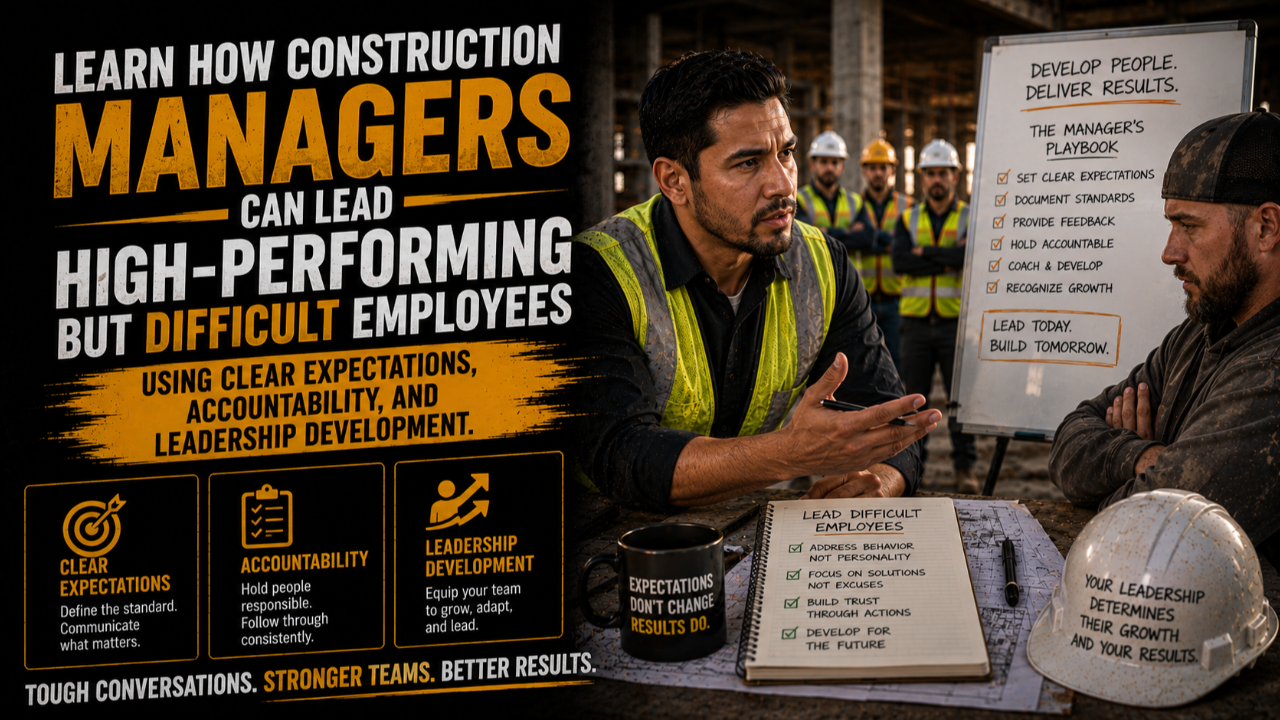
Managing high performers isn't about protecting production it's about protecting your team.
The most effective leaders clearly communicate career ceilings, separate willingness from capability, and refuse to let toxic behavior become the standard.
Technical excellence matters.
But leadership is what determines whether that excellence strengthens the team or slowly tears it apart.
Key Questions Answered
- How do you manage a high-performing employee with a bad attitude?
- When should you coach versus let someone go?
- Why do talented people become "untouchable"?
- What's the difference between willingness and capability?
- How can construction managers build stronger leaders instead of just better performers?
Your Best Employee Might Be Destroying Your Team (And It Could Be Your Fault)
I know this conversation makes some people uncomfortable.
You've got that one person.
They hit production goals.
They know the work inside and out.
They solve problems nobody else can solve.
And they make everyone around them miserable.
I've been there.
Actually...
I was that guy.
I was technically strong. I could make money. I could finish jobs. I knew I was one of the best in the field.
And because I knew it...
I thought the rules didn't apply to me.
That's exactly why I wanted to have this conversation.
Because if you're leading construction teams, sooner or later you're going to have someone whose technical skill is carrying the company while their behavior is slowly poisoning the culture.
The question isn't whether they produce.
The question is whether they're making everyone else worse.
Why Do High Performers Become So Hard to Manage?
Here's what most managers miss.
Technical ability creates leverage.
If someone knows they're difficult to replace, they start believing they're untouchable.
Sometimes they're right.
That's where leaders get stuck.
They tolerate behavior they would never accept from anyone else because they're afraid production will suffer.
But here's the truth...
Every day you tolerate that behavior, you're training everyone else on what's acceptable.
Your crew notices.
Your future leaders notice.
Your customers definitely notice.
The cost isn't measured in today's production numbers.
It's measured in tomorrow's turnover, morale, and leadership pipeline.
The Conversation That Changed My Career
I still remember the conversation my boss had with me.
He didn't threaten to fire me.
He didn't yell.
He didn't tell me I wasn't good enough.
Instead, he painted a picture of my future.
He told me something I'll never forget.
"You do great work... but this is as far as you're ever going if you don't change how you lead people."
That hit differently.
Money didn't motivate me.
A promotion didn't motivate me.
What motivated me was realizing I'd eventually have to report to people I believed were less capable than I was.
That was enough.
Suddenly I wanted to learn.
Suddenly I wanted coaching.
Suddenly I became willing.
That's one of the biggest leadership lessons I've ever learned.
Sometimes people don't need another warning.
They need a clear picture of the ceiling they're creating for themselves.
Are You Coaching the Right Problem?
When managers see poor behavior, they often jump straight to discipline.
I think there's a better question first.
Is this a willingness problem...
Or a capability problem?
Those are two completely different issues.
If someone is willing but lacks capability...
Train them.
Coach them.
Mentor them.
Give them resources.
Most people can learn.
But if someone has all the capability in the world and refuses to change...
Now you're dealing with willingness.
That's an entirely different conversation.
You can't train someone into caring.
You can't mentor someone who refuses to grow.
And you definitely can't build a championship team around someone who's actively undermining everyone else.
Capability Can Be Developed. Character Requires Choice.
I've always believed leaders should fight for people.
Support them.
Invest in them.
Give them every reasonable opportunity to succeed.
But that doesn't mean you ignore repeated unwillingness.
If someone refuses accountability...
Refuses feedback...
Refuses teamwork...
Eventually, keeping them isn't kindness.
It's leadership avoidance.
Sometimes the most responsible thing you can do for your team and even for that individual is let them find an environment that's a better fit.
I've had people come back years later and thank me after being let go.
Not because getting fired felt good.
Because it forced them into a place where they finally fit.
Leadership isn't about hanging onto everyone forever.
It's about doing what's best for the people and the mission.
Construction Doesn't Need More Heroes. It Needs Better Leaders.
Too many companies build their business around one superstar.
One estimator.
One superintendent.
One foreman.
One project manager.
That's not leadership.
That's dependency.
Real leadership builds systems.
It develops people.
It creates teams that perform because everyone contributes not because one difficult employee carries the load.
If your company falls apart because one person leaves...
That isn't proof they're indispensable.
It's proof you've allowed too much dependence to develop.
This Is Exactly What We Build Inside the Construction Leadership Lab
The best leaders don't just know construction.
They know people.
They know how to have hard conversations.
They know how to develop talent.
They know when to coach, when to train, when to challenge, and when to make difficult decisions.
That's exactly the shift we build inside the Construction Leadership Lab.
Because the future of construction leadership isn't about finding more technically gifted people.
It's about developing leaders who can multiply the talent around them.
When managers learn that skill, everything changes.
Production improves.
Retention improves.
Culture improves.
And suddenly the business isn't being held hostage by one person's ego.
Quick Answers
How do you manage a high-performing employee with a bad attitude?
Clearly explain how their behavior limits their future, then coach them if they're willing to improve.
What's the difference between willingness and capability?
Capability can usually be developed through training. Willingness is a personal choice to accept coaching and change.
When should you let someone go?
After they've been given support, clear expectations, and opportunities to improve—but remain unwilling to change.
Ready to Build Better Leaders?
If this conversation hit home, you're not alone.
And if you're serious about becoming a stronger leader, don't stop there. Explore the Construction Leadership Lab, where we're helping construction managers become the kind of leaders people actually want to follow.
Lets keep working to leave the construction industry better than we found it.