
Stop Seeking Approval: A Guide for New Construction Leaders
Jul 16, 2026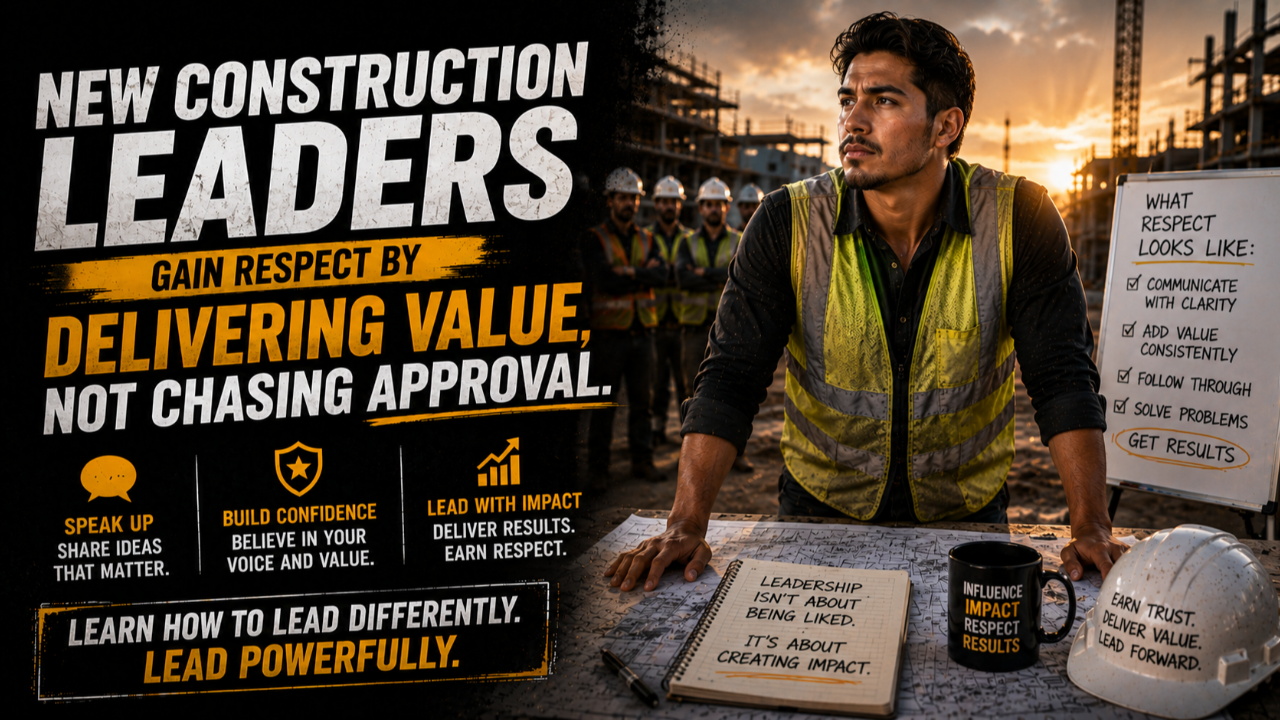
The fastest way to stall your leadership career is to spend it trying to earn everyone's approval. New construction leaders often stay quiet because they don't want to rock the boat—but that's exactly what keeps them invisible. The leaders who grow the fastest aren't the loudest. They're the ones who consistently deliver value, ask better questions, and have the courage to speak when it matters.
Key Questions Answered:
- Why do new construction leaders struggle to speak up?
- What's the difference between seeking validation and delivering value?
- How do you earn respect without trying to please everyone?
- What happens when you finally trust your own judgment?
- How can new field leaders build confidence faster?
Stop Waiting for Someone to Tell You You're Ready
You got the promotion.
Now comes the hard part.
You're leading crews that used to be your peers. You're sitting in meetings with superintendents, project managers, and executives. Every decision feels bigger than it did yesterday.
And whether you realize it or not, there's a voice running in the background.
"What if I'm wrong?"
"What if they don't respect me?"
"What if I speak up and everyone realizes I don't belong here?"
That voice isn't protecting you.
It's trapping you.
Too many new construction leaders spend their first years chasing approval instead of creating value. They wait for permission to lead.
Leadership doesn't work that way.
Why Do New Construction Leaders Stay Quiet?
Because silence feels safe.
If you don't challenge an idea...
If you don't ask the hard question...
If you don't offer another perspective...
Nobody can criticize you.
At least that's what it feels like.
The problem is that every time you stay quiet, you teach people exactly what to expect from you.
You become dependable.
You become agreeable.
But you don't become influential.
Construction projects don't move forward because everyone agrees. They move forward because someone identifies risks early, solves problems quickly, and isn't afraid to have uncomfortable conversations.
That's leadership.
What's the Difference Between Validation and Value?
Validation depends on everyone else.
Value comes from what you contribute.
Those are two completely different games.
When you're chasing validation, you're asking:
- Do they like me?
- Did I say the right thing?
- Did I make everyone happy?
- Do I fit in?
When you're delivering value, you're asking:
- What problem needs solving?
- What am I seeing that others aren't?
- How can I help this team succeed?
- What's the truth that needs to be said?
One mindset keeps you small.
The other builds leaders.
The reality is simple:
Your company promoted you because they believed you could contribute more not because they wanted another person who simply agreed with everyone else.
Why Does Speaking Up Feel So Risky?
Because it is.
Leadership always carries risk.
The first time you challenge a process...
The first time you disagree with a superintendent...
The first time you admit you don't know something...
Your heart races.
That's normal.
But here's what most new leaders never discover:
The biggest risk isn't speaking up.
The biggest risk is staying quiet until problems become disasters.
Construction rewards people who solve problems early.
Silence delays solutions.
And delayed solutions always cost more.
How Do You Build Confidence Without Pretending You Have All the Answers?
Confidence isn't knowing everything.
Confidence is trusting that you'll figure things out.
The strongest field leaders aren't walking around acting like experts every minute of the day.
They're curious.
They ask questions.
They listen.
Then they contribute when they have something meaningful to add.
That's a huge difference.
You don't earn credibility by talking the most.
You earn credibility by adding value consistently.
Every conversation.
Every meeting.
Every jobsite.
What Happens When You Stop Trying to Please Everyone?
Something surprising.
People start trusting you more.
Not everyone.
Some people will resist.
Some people prefer leaders who never challenge the status quo.
That's okay.
Your job isn't to make everyone comfortable.
Your job is to help the team succeed.
The leaders who earn lasting respect are willing to have the conversations others avoid.
They're willing to ask:
"Why are we doing it this way?"
"Is there a better option?"
"What problem are we missing?"
That's where improvement starts.
Three Ways to Start Leading With Value Today
1. Speak when you have some insight to share
You don't have to dominate the conversation.
Ask one thoughtful question.
Offer one observation.
Share one concern.
Build the habit.
2. Solve problems not personalities.
Stop worrying about who gets credit.
Focus on making the project better.
People notice leaders who improve outcomes.
3. Measure yourself differently.
Instead of asking:
"Did everyone like what I said?"
Ask:
"Did I make the conversation better?"
That's a far more powerful scorecard.
Quick Q&A
How do I know if I'm seeking validation?
If you're making decisions primarily to avoid criticism or gain approval, you're probably chasing validation.
What if I speak up and I'm wrong?
Great leaders are wrong sometimes. They learn quickly, adjust, and keep moving.
Will everyone appreciate me speaking up?
No. But leadership has never been about unanimous approval.
Can quiet leaders still be influential?
Absolutely. Influence comes from consistent value, not volume.
This Is Exactly What New Construction Leaders Need
Most companies teach new supervisors how to manage schedules, production, safety, and paperwork.
Very few teach them how to think like leaders.
That's why so many talented field leaders spend years second-guessing themselves.
This is exactly the shift we build inside The Construction Leadership Lab.
The Construction Leadership Lab gives emerging leaders practical tools to communicate with confidence, navigate difficult conversations, build trust, and lead crews without relying on titles or approval. It helps leaders develop the mindset and habits that create long-term influence before bad habits become permanent.
Because leadership isn't about waiting until you feel confident.
It's about becoming the kind of leader your crew can trust even while you're still growing.
Final Thought
Your promotion wasn't an invitation to fit in.
It was an invitation to contribute.
Every project needs someone willing to ask the question everyone else is avoiding.
Every crew needs someone willing to solve problems instead of protecting their ego.
That leader can be you.
Stop chasing approval.
Start delivering value.
Everything changes after that.