
Why Your Team Waits for You to Solve Everything
Oct 14, 2026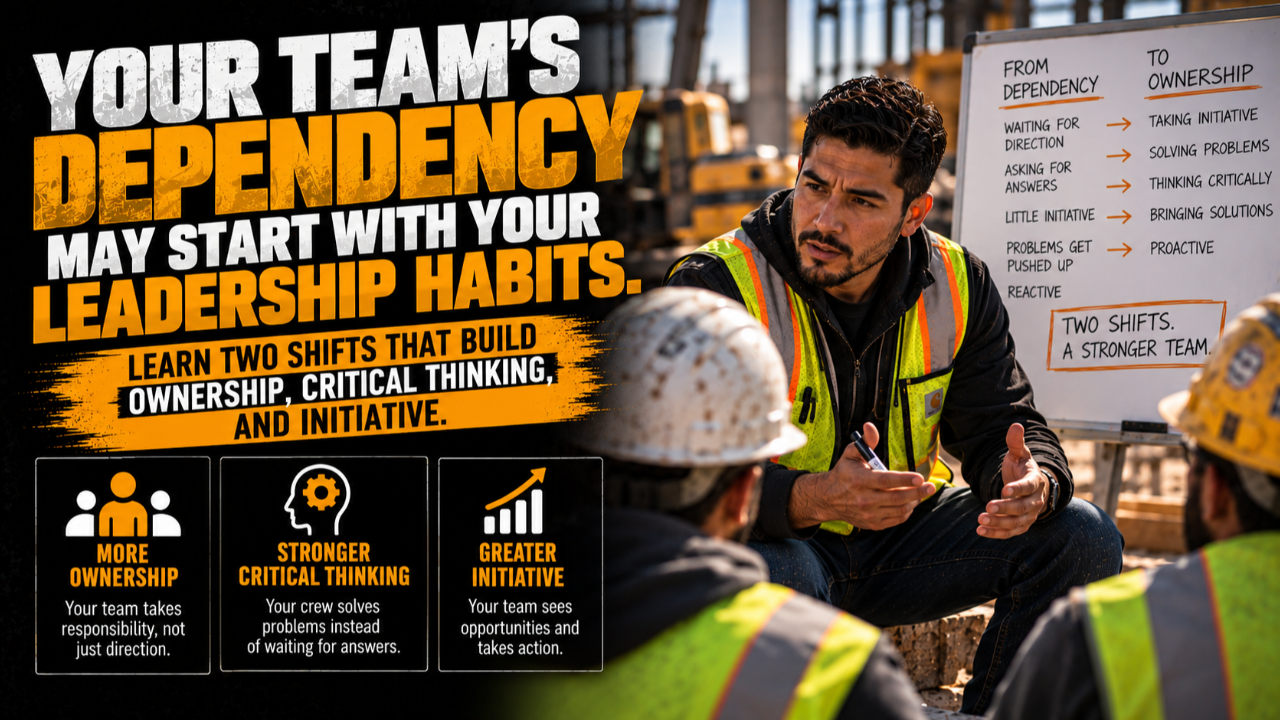
If your team constantly waits for you to solve everything, stop assuming the problem is only them. Your habit of immediately giving answers may be teaching people to depend on you. Breaking that cycle requires two shifts: changing how you think about “solving” problems and changing how you respond when someone brings you one. The goal isn’t to stop supporting your people. It’s to support them without stealing their ownership.
Why Your Team Waits for You to Solve Everything
If your team brings you every damn problem, waits for you to make every decision, and seems incapable of taking initiative without checking with you first, I’ve got some uncomfortable news.
You might be the reason.
You are a victim of Solutionizer Syndrome.
You’re good at solving problems. You’ve got experience. You can see the answer faster than most people can explain the problem.
So somebody brings you an issue, and BAM you give them the answer.
Efficient, right?
Not exactly.
Because every time you solve something for your people, you might be training them to bring the next problem right back to you.
And eventually you become the easy button for the entire damn team.
Key Questions Answered
-
Why does my team bring every problem to me?
-
How can constantly giving answers create dependency?
-
Why does fixing problems feel productive when it may actually cost me time?
-
How can I get my team to think and make decisions for themselves?
-
What simple question can stop me from automatically solving everything?
What Are the Warning Signs of Solutionizer Syndrome?
I know this one because I’m a recovering solutionizer.
I have answers.
I have experience.
And when somebody tells me about a problem, my brain immediately starts firing:
“You should do this.”
“Here’s what I would do.”
“I dealt with that before. Do this.”
Sound familiar?
One warning sign is frustration because people don't follow your advice.
You told them exactly what to do. They didn't do it. Now you're irritated.
But the bigger warning sign is when people stop trying before they come to you.
Eventually you're thinking:
Can you make one damn decision without me?
That's when Solutionizer Syndrome has gotten expensive.
Why Does Solving Everything for Your Team Make the Problem Worse?
Here’s the trap.
Giving somebody the answer feels faster.
And today, it probably is.
But leadership isn't only about getting through today's problem.
When I continually give people answers, they get less practice thinking through problems themselves. I become the shortcut.
Then I get interrupted more.
I become more reactive.
My work gets pushed later.
I stay late because I spent the day fixing everybody else's crap.
Then I complain that nobody takes initiative.
That's a brutal loop.
And it's one of the reasons construction leadership training has to go beyond teaching leaders how to know more. We have to learn when not to give the answer.
What Is the Real Cost of Always Being the Fixer?
The obvious cost is time.
The deeper cost is ownership.
Let's say I tell somebody exactly what to do.
They do it.
It doesn't work.
What's the easiest response?
“Well, I did what you told me to do.”
Boom.
Ownership transferred.
Now it's partly my problem because I made the decision for them.
Repeat that enough times and I've created dependency.
Problem → Bring it to Jesse → Jesse gives answer → Try answer → Bring next problem to Jesse.
Congratulations.
I've made myself the easy button.
That's not construction leadership development.
That's dependency disguised as helpfulness.
What Two Leadership Shifts Can Break the Dependency Loop?
I use two shifts.
The mind shift: Stop assuming giving an answer means I solved the problem.
The behavior shift: Stop giving answers until we've agreed on what kind of conversation we're actually having.
Neither one requires some giant leadership initiative.
But both require reps.
This is exactly the kind of shift we build inside the Construction Leadership Lab because knowing leadership theory isn't enough. Leaders need somewhere to examine their habits, test different approaches, and learn alongside other experienced construction leaders dealing with the same messy human problems.
What Is the Mind Shift Leaders Need to Make?
Here's my reality check:
Did I actually solve the problem or did I just feel like I solved it?
Those aren't the same thing.
If somebody tells me about an issue and I dump my wisdom on them, I haven't necessarily solved anything.
I've made mouth noise.
Maybe good mouth noise.
Maybe brilliant mouth noise.
But still mouth noise.
For me to claim my recommendation solved the problem, they would have to take the action and that action would have to produce the outcome they wanted.
Otherwise, I just gave advice.
That distinction matters.
Because once I stop getting my leadership dopamine hit from having the answer, I can start focusing on something more valuable:
Building their ability to think.
How Does the Dependency Loop Keep Your Team From Thinking?
Leaders accidentally train behavior all the time.
If every time someone brings me a problem I immediately provide the solution, what am I teaching them?
Bring Jesse problems.
Why wrestle with the issue?
Why evaluate options?
Why make a call?
Jesse will tell me.
Then I get frustrated because they're dependent on me.
That's the part we have to own.
If I want more leadership skills in construction, more critical thinking, and more autonomy from the people around me, I have to give them room to use those muscles.
It might take longer today.
That's okay.
Because I'm investing in fewer interruptions tomorrow.
What Behavioral Shift Stops You From Automatically Giving Advice?
This one is stupid simple:
Get agreement on the problem before solving anything.
Someone comes into my office hot about a situation.
Instead of immediately saying what they should do, I ask:
“Are you venting, brainstorming, or do you want help?”
That question changes everything.
Maybe they just need to vent.
Cool. I'll listen.
Maybe they're bouncing ideas around.
Cool. I'll ask questions.
Maybe they genuinely don't know what to do and want my experience.
Cool. Now I have permission to help.
But I don't need to hijack every conversation and turn it into a problem-solving session.
Quick Leadership Check
Before giving your next answer, ask yourself:
-
Did they actually ask for my help?
-
Are they venting or looking for a solution?
-
Have I asked what they think?
-
Who owns the decision when this conversation ends?
That tiny pause can completely change how your team interacts with you.
Why Should You Ask “Are You Venting or Do You Want Help?”
Because unsolicited advice can wreck connection.
We've all experienced it.
You're talking about something frustrating and the other person immediately starts hammering you with:
“You know what you should do…”
Maybe I don't want to know what I should do.
Maybe I just wanted somebody to listen.
When I assume every frustration is a request for my wisdom, I risk making people feel like I don't trust them to think.
So I ask.
Venting, brainstorming, or help?
Simple.
Direct.
Clear.
How Do Permission and Ownership Create Stronger Construction Leaders?
Even when someone wants my help, I don't want to take ownership away from them.
I can say:
“I'll give you some recommendations, but it's up to you to decide what you're going to do and carry it forward.”
Now the roles are clear.
I've got their back.
I'll point out blind spots.
I'll help them see options.
But they still own the problem.
And if I notice something they aren't seeing?
I can ask permission there too:
“I've noticed something. Are you okay with me sharing it?”
That's radically different from:
“Here's what you're doing wrong and what you need to do.”
Permission preserves agency.
Ownership builds capability.
Capability creates independence.
And independence gives leaders their time back.
That's the kind of construction leadership and management training I care about.
Not creating leaders who have every answer.
Creating leaders who build people capable of finding answers without them.
Q&A: What If It’s Faster for Me to Just Fix It?
It probably is today. But if you're always the fastest route to an answer, don't be surprised when everybody keeps taking that route.
What if they genuinely don't know what to do?
Help them. Give them perspective and options. Just make it clear that they still own the decision and the action.
Won't this take longer?
At first, yes. But developing critical thinkers now means fewer interruptions and less dependency later.
Does this mean I should stop giving advice?
No. It means stop giving advice automatically. Get permission first.
Stop Being Your Team's Easy Button
If you're frustrated because nobody makes a decision without you, look at the system you've helped create.
Being the person with all the answers can feel like leadership.
Sometimes it's just control wearing a hard hat.
Real leadership is building people who can think, decide, act, learn, and own outcomes.
That's why we have conversations like this inside the Construction Leadership Lab. It's a community of construction leaders committed to building their skills, learning from one another, and leaving this industry better than they found it.
Because the goal isn't to make yourself more necessary.
The goal is to make your people more capable.