
Your Promotion didn't Make You a Better Leader, Now What?
Nov 07, 2026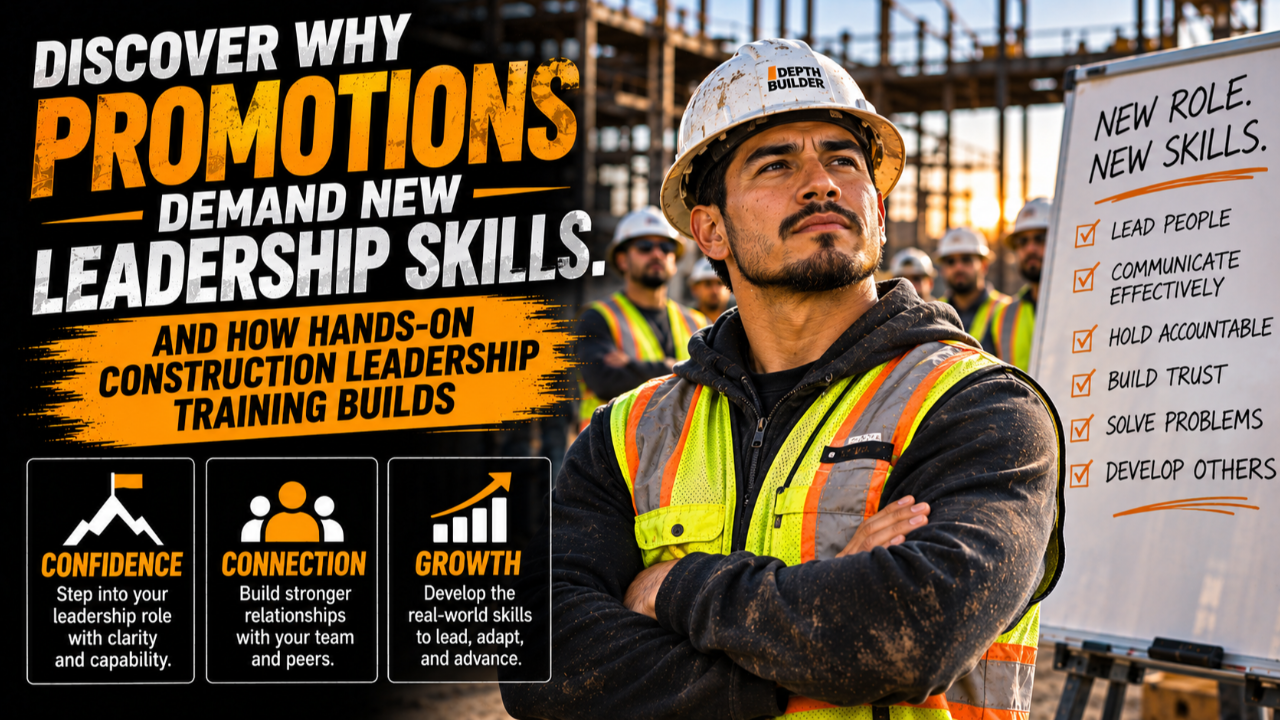
A promotion doesn't automatically prepare you for the responsibilities of leadership. Many construction professionals struggle with isolation, self-doubt, and the pressure to have every answer. Real leadership growth happens when we practice new skills, connect with people who understand our challenges, and stay curious. The In Person Construction Leadership Lab is being designed to create exactly that kind of learning experience.
You got the promotion. Congratulations. Now comes the part nobody warned you about.
Yesterday, you were crushing it. You knew your job, solved problems, and earned the respect of your crew.
Today? You're responsible for more people, bigger decisions, and problems you've never seen before.
And somehow, everybody expects you to have the answers.
Welcome to construction leadership.
Here's the uncomfortable truth: Getting promoted doesn't mean you've mastered leadership. It means you've earned the opportunity to learn an entirely new set of skills.
And if you're a lifelong learner, that's good news.
Because the best construction leaders aren't the ones who know everything. They're the ones who refuse to stop growing.
Key Questions Answered
-
Why do newly promoted construction leaders struggle?
-
How does isolation contribute to leadership burnout?
-
Why are communication and vulnerability critical leadership skills?
-
What makes hands-on construction leadership training different?
-
How can construction professionals help shape better leadership development?
Why Do Construction Leaders Struggle After Getting Promoted?
Because the skills that earned your promotion aren't necessarily the skills that will make you successful in your new position.
Think about it.
You became an excellent foreman because you understood production, solved problems, and knew how to get shit done.
Then somebody handed you a superintendent position.
Suddenly, you're managing other leaders, handling competing priorities, navigating conflict, and making decisions that affect dozens or hundreds of people.
Nobody handed you a new operating manual.
During a recent conversation about The Construction Leadership Lab, I was asked who needs leadership development the most.
My answer was simple.
Anybody who has been promoted within the last three years.
Not because they're failing.
Because they're operating in a new environment with an old set of tools.
Your promotion isn't proof that you don't need training.
It's evidence that your next level of development has arrived.
That's why construction leadership training should be a continuous process, not something you complete once and forget.
Why Does Leadership Feel So Lonely in Construction?
Here's something I've experienced at nearly every level of this industry.
You can work around hundreds of people every day and still feel completely alone.
I've experienced construction from the installer's perspective through senior operations leadership.
The titles change. The responsibilities grow.
But one thing stays remarkably consistent.
Isolation.
And the higher you climb, the harder it can become to admit you're struggling.
You can't always tell your boss you're uncertain.
You might hesitate to tell your peers you made a mistake.
You don't want your crew questioning your confidence.
So you carry everything yourself.
You show up looking successful while privately feeling like you're drowning.
That pressure follows you home.
It affects your patience, relationships, energy, and ability to recover.
And eventually, it can contribute to burnout.
The problem isn't that construction leaders aren't tough enough.
The problem is that we've built working environments where asking for help can feel dangerous.
We need to change that.
Not by making everybody soft.
By making connection, trust, and continuous learning part of how we lead.
What Leadership Skills Matter More Than Technical Knowledge?
Technical knowledge matters.
But your ability to communicate, collaborate, negotiate, and understand people becomes increasingly important as your responsibilities grow.
In early responses to the Construction Leadership Lab Survey, communication emerged as the most requested development topic.
That doesn't surprise me.
Because most leadership problems involve another human being.
Consider this simple question:
"Are you venting, or do you want help solving the problem?"
That's it.
One question.
Imagine how many arguments, misunderstandings, and unnecessary frustrations could disappear if we asked that before offering advice.
Your superintendent brings you a problem.
You immediately start explaining what they should do.
But maybe they weren't asking you to fix anything.
Maybe they needed somebody to listen while they worked through their thinking.
When leaders constantly jump into solution mode, they can unintentionally communicate that their people aren't capable.
Learning to listen changes that dynamic.
And here's the beautiful part.
The same skill makes you a better spouse, parent, friend, and teammate.
Leadership development shouldn't stop working when you clock out.
Why Is Asking for Help a Leadership Strength?
Construction professionals understand personal protective equipment.
Hard hats. Safety glasses. Steel-toe boots.
We wear equipment to protect ourselves from physical injuries.
But somewhere along the way, we started behaving like our hard hats could protect us from emotional pain, too.
They can't.
We still experience fear, uncertainty, disappointment, and self-doubt.
We just get really good at hiding it.
For much of my career, I believed admitting I didn't know something would destroy my credibility.
Turns out, saying "I don't know" or "I need help" doesn't automatically make the world fall apart.
Sometimes it creates the trust we've been missing.
That's vulnerability.
Not standing in front of strangers telling your deepest secrets.
Simply having enough courage to admit you're human.
And when leaders practice that skill, they give other people permission to do the same.
Why Doesn't Traditional Construction Leadership Training Always Work?
We've all attended conferences.
Big keynote speakers. Packed schedules. Forty-five-minute breakout sessions.
You leave feeling energized.
But three weeks later, what can you actually do differently?
That's the question.
Information isn't the same as transformation.
Knowing something and being able to do it are two different things.
The In Person Construction Leadership Lab is being designed around that distinction.
The vision is a two-day, in-person experience built around extended, hands-on workshops facilitated by accomplished construction professionals.
Not people who simply studied leadership.
People who've practiced it, struggled with it, and learned what actually works.
Participants would practice real skills together, receive feedback, and build relationships through shared experiences.
Because meaningful connection doesn't happen just by exchanging business cards.
It happens when people learn, struggle, and improve together.
This is exactly the shift we're working to build inside The In Person Construction Leadership Lab.
How Can Construction Leaders Help Build Better Training?
Here's where you come in.
We're not interested in building another conference where somebody decides what construction professionals need without asking them.
We want to hear directly from the people doing the work.
What skills would make you more effective?
Communication? Negotiation? Collaboration? Emotional intelligence?
What would help you lead better at work and show up better at home?
That's why we're gathering input through the In-Person Construction Leadership Lab Survey.
Your responses will help inform the workshop topics and learning experience.
Whether you're a foreman, superintendent, project manager, or senior executive, your perspective matters.
Especially if you're the kind of leader who understands that learning never stops.
What Should Every Lifelong Construction Learner Remember?
You don't need to pretend you've figured everything out.
You don't need another promotion to justify investing in yourself.
And you definitely don't need to wait until you're burned out before building relationships with people who understand your world.
Your next breakthrough might come from learning a new skill.
It might come from meeting somebody who's already solved the problem you're facing.
Or it might start with admitting you don't have all the answers.
The goal isn't to become a leader who never struggles.
The goal is to become a leader who knows how to keep growing.
Frequently Asked Questions
Who is construction leadership development for?
Foremen, superintendents, project managers, executives, and anyone preparing for greater responsibility. It's especially valuable during the first three years after a promotion.
Can experienced construction leaders benefit from training?
Absolutely. New responsibilities create new challenges, and even familiar skills require refinement in different leadership roles.
What makes The In Person Construction Leadership Lab different?
This experience will emphasize extended, interactive workshops, practical skill development, and meaningful relationships instead of passive presentations.
How can I influence the workshop topics?
Help Build the Construction Leadership Experience You Actually Need
We're planning an in-person Construction Leadership Lab in San Antonio, with June as the target month. Event details are still being developed.
But you don't have to wait to help shape it.
Take the In-Person Construction Leadership Lab Survey
Tell us what you want to learn, what challenges you're facing, and what would make this experience worth your time.